Highlights

Highlights

Map of Montana/Idaho (Click to enlarge)


Wyoming

Highlights Along or Near the Trail

Glacier National Park

Montana & Idaho

Glacier National Park encompasses more than one million acres of protected habitat supporting an incredible variety of wildlife and wildflowers, and reflects the rugged natural beauty of the Rocky Mountains. The park contains over 350 structures listed on the National Register of Historical Sites and six National Historic Landmarks. Due to its remote location and geological history, Glacier National Park contains particularly rich biological diversity of plant and animal species. This combination of spectacular scenery, diverse flora and fauna, and relative isolation from major population centers have combined to make Glacier National Park the center of one of the largest and most intact ecosystems in North America.

The geological history of Glacier National Park is visible in the numerous exposed layers of Precambrian sedimentary formations. Dating back over one billion years. Subsequent sculpting by massive bodies of ice have transformed this area into a dramatic example of glacial landforms. Today several small alpine glaciers of relatively recent origin dot the mountains.

In 1932 Glacier and Waterton Lakes National Park, in Canada, were designated Waterton-Glacier International Peace Park. This designation celebrates the longstanding peace and friendship between Canada and the United States.

Logan Pass
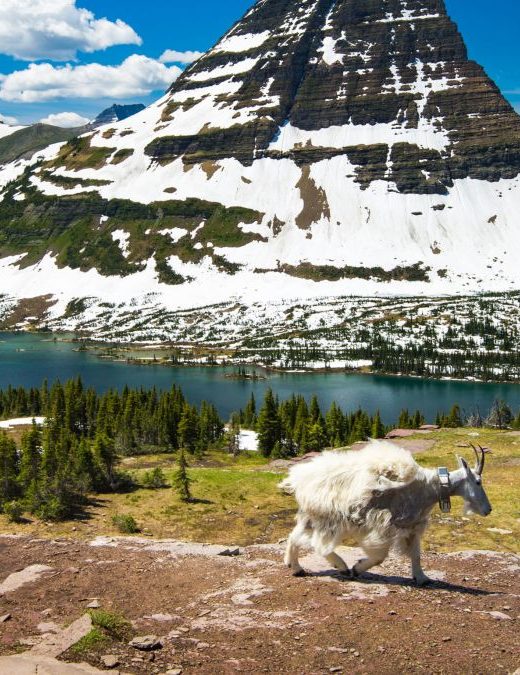
Logan Pass, the Crown of the Continent, is west of the route of the CDT, on the Going-to-the-Sun Road. The visitor’s center is full of displays that feature the history, flora, and fauna of Glacier National Park. A trail that begins as a boardwalk near the visitor’s center leads southwest to Hidden Lake. This is the shortest route to Glacier’s high country near Bearhat Mountain. North of the highway, the Highline Trail begins, offering a day hike to Granite Park Chalet and Swiftcurrent Pass. When Piegan Pass is snowed in, this route serves as an alternate access point to the Continental Divide Trail.

Triple Divide Mountain
The Triple Divide Mountain is a unique focal point of the continent’s drainage. From its slopes, water drains to the Pacific, Atlantic, and Arctic Oceans.

Marias Pass
Indians traveling from the Blackfoot Nation to the Flathead and Kootenai Nations often used mile high Marias Pass, the lowest Continental Divide pass north of Lordsburg, New Mexico.

Bob Marshall Wilderness
The Bob Marshall Wilderness is one of the most completely preserved mountain ecosystems in the world, the kind of Wilderness most people can only imagine: rugged peaks, alpine lakes, cascading waterfalls, grassy meadows embellished with shimmering streams, a towering coniferous forest, and big river valleys.

The Wilderness runs for 60 miles along the Continental Divide, with elevations ranging from 4,000 feet to more than 9,000 feet. The Bob Marshall Wilderness is the last holdout habitat south of Canada for the grizzly bear.

Chinese Wall

Chinese Wall

The Chinese Wall, the longest section of continuous cliff formation in the Rocky Mountains, highlights the vast untrammeled beauty, with an average height of more than 1,000 feet and a length of approximately 12 miles. The Wall is a result of a thrust fault, with cliffs made up of Cambrian limestone.

Marysville
Prehistoric force laid the foundations for the gold and silver rush that spawned the Boomtown of Marysville, Montana, in 1876. Fossils provide evidence into Montana’s ancient landscape. Where the land once covered by an ancient sea was uplifted by volcanic activity hiding deep within the mountain ranges gold, silver, lead, zinc, copper, coal and sapphires.

Marysville

Today, the most evident fossils are the dilapidated buildings, cars, cabins, and mine shafts that litter the landscape. The past is mixed with the present. Old buildings lean against new. The town has not been gussied up for the tourist trade, but it does have a post office that accepts general delivery packages for hikers.

Lewis and Clark Pass
On their return journey in 1806, Captain Lewis parted ways with Captain Clark at Travelers Rest to explore a shorter way back across the Continental Divide and to determine the northern boundary of the Louisiana Territory. With a party of 14 men and 17 horses they followed the Blackfoot River and a route their Nez Perce guides called the Cokahlarishkit trail over what is now called Lewis and Clark Pass. The pass is off Forest Service Road 293 about 10 miles from Highway 200.

Butte
Like many mining camps, Butte came into existence because of gold. Yet, by 1870 placer mining, the easiest method of gold extraction was phasing out. While most miners drifted away to other promising mineral strikes, a few far-sighted individuals labored on in Butte trying to solve the puzzle of freeing gold, silver, copper, manganese, zinc, and lead from a tightly locked matrix of quartz. Through the 1870’s, silver mining kept Butte alive. At the end of the decade, three critical elements came together: Butte miners struck the richest deposit of copper ever found; advanced smelting technology made it profitable to extract the copper and other metals: and railroads reached Butte to cut the cost of transportation to eastern manufacturers.

At the same time the electricity and telecommunications industries were getting under way. For instruments and equipment, as well as millions of miles of delivery of wire and cable, copper was the material of choice. Butte quickly boomed into a mini New York with lavish theaters, posh hotels and fine restaurants.

Anaconda – Pintler Wilderness

United States Congress designated the 158,600 acre Anaconda-Pintler Wilderness in 1964. Straddling the Continental Divide in the Anaconda Range, it has it all in terms of mountain grandeur, whether that entails high and rugged peaks, cirques, U-shaped valleys, or glacier moraines. Sparkling lakes and tumbling streams fed by icy water running off snowfields above the timberline enhance the beauty and offer excellent fishing for species of trout, three of char, mountain whitefish, and arctic grayling.

Gibbons Pass and Trail Creek
Determined to find a better route over the Continental Divide, Lewis and Clark parted company at Traveler’s Rest near Lolo, Montana on July 3, 1806. Lewis headed northeast through Hellgate Canyon and over Lewis and Clark Pass while Clark followed the Bitterroot River southeast to near present day Sula. Clark’s party then followed an ancient Indian route that rose from the valley floor to what is now Gibbons Pass and descended into the Big Hole Valley. Chief Joseph and other non-treaty Nez Perce would traverse this same route to reach the Big Hole Valley during the Nez Perce War of 1877.

Big Hole Battlefield National Monument

Big Hole Battlefield National Monument preserves part of the major scene of battle along the route of the epic retreat, from present day Idaho towards the Canadian Border, of five fleeing Nez Perce Indian bands during the summer of 1877. Here on August 9 and 10, occurred one of the more dramatic and tragic episodes during the long struggle in the U.S. to confine Indians to designated reservations and force them off the land wanted by whites. Today, mute evidence in the forms of trenches and battle-scarred trees still recalls one of the more fierce chapters of the nineteenth century Indian warfare.

Chief Joseph Pass
This pass is named after Chief Joseph who was chief of the Wallowa band of the Nez Perce and one of the leaders of the Native American resistance to white encroachment in the United States. His Nez Perce name was In-mut-too-yah-lat-lat, which means “thunder coming from the water over the land.”

Lemhi Pass

At an elevation of 7,323 feet, Lemhi Pass is a rounded saddle in the Beaverhead Mountains of the Bitterroot Range, along the Continental Divide, between Montana and Idaho. Here in 1805, the Lewis and Clark expedition first saw the headwaters of the Columbia River, which flows to the Pacific Ocean, and crossed what was then the western boundary of the United States. Lemhi Pass was designated a National Historic Landmark in 1960 for its significance to the Lewis and Clark expedition.

Bannack Pass
Figured heavily in Montana history, Bannack Pass, once a railroad route, furnished the most direct route from Montana goldfields to south Idaho. There is still evidence of the old abandoned railroad tunnel under this pass. Bannack Pass is also significant as a historic route for herds of migrating buffalo. The once well trammeled buffalo trails are now grown over but modern day finds of buffalo skulls bear witness to the earlier importance of this pass.

Red Conglomerate Peaks

Montana & Idaho

The Red Conglomerate Peaks is a unique geological formation and a nesting place for the rare golden eagle.

Red Rock Lakes National Wildlife Refuge
Red Rock Lakes National Wildlife Refuge has often been called the most beautiful national wildlife refuge in the United States. The rugged Centennial Mountains, rising more than 9,000 feet above the Centennial Valley wetlands, provides a dramatic backdrop for this extremely remote Refuge. The Inherent solitude and suitable habitat has made this the perfect place for reviving declining populations of the majestic trumpeter swan.

Island Park Caldera
Island Park is the world’s largest recognized caldera, a collapsed volcanic chamber about 18 to 23 miles in diameter, and shaped like an enormous shallow bowl. Roughly half a million years ago, large shield volcanoes erupted in what is now eastern Idaho. The CDT traverses the eastern edge of Island Park Caldera, and the western edge of the Yellowstone Caldera. According to geological records of past eruptions, this area is due to explode again soon.

Hell Roaring Creek
Hell Roaring Creek is the most distant headwater of the Missouri River. The creek’s waters end up in the Gulf of Mexico, some 4,200 miles downstream.